

On CNBC’s Squawk Box yesterday, I had the opportunity to discuss California’s proposed billionaire tax with two of the show’s sharp hosts, Andrew Ross Sorkin and Joe Kernen, along with an architect of the billionaire tax himself, Gabriel Zucman. I’ve queued the video up to the moment where I interjected with “oh please”:
I expected more back-and-forth on our competing claims about the tax’s likely revenue effects. The team behind the proposition continues to say that the tax will raise $100 billion for California. Ben Jaros and I have scored the legislation taking into account documented billionaire exits, the legal challenges that threaten collection, and the net present value of the income taxes the state loses as a result. We conclude that it is a money loser for the state, which on average over a range of possible outcomes loses $39 billion.
Even voters who want to punish billionaires or who care only about inequality should be aware of the economic consequences. How much harm are they willing to inflict on the economy they work in and on the state budget itself to get there?
Two other issues got less airtime than they deserved.
First, the claim that billionaires pay little or no tax. It came up several times, and we did address it head-on at the end, but Zucman’s version of it is incorrect. Both his team’s paper and ours estimate that California billionaires pay billions per year in state income tax. Their series reaches $4.3 billion in 2025; ours puts it at $3.3–5.8 billion. We point out that these payments are growing and closely tied to the stock market.
In order to claim that some billionaires pay no tax, Zucman instead cites other work of his based on SEC filings (Forms 4 and 144, and proxy statements). Those filings only cover insiders’ transactions in their own company’s securities. Much of a founder’s taxable income never shows up there. The investments in their family offices generate taxable dividends and capital gains. The hedge funds and VC funds they invest in generate taxable income. Secondary sales of private stock generate taxable income. The conclusion that they don’t pay much tax is unfounded.
Second, Kernen and Zucman had a vigorous back-and-forth about France versus Silicon Valley. There is real irony in watching Zucman, with France’s economy in crisis, propose bringing the same methods to California’s world-class startup ecosystem. But we never got to the question I most wanted to ask: how does Zucman think the startup ecosystem survives his wealth taxes? I mean both the California version and the national wealth taxes he has championed, which start at levels like $50 million.
It’s difficult to get a precise count but I would estimate that hundreds of US startups each year raise a Series A at a valuation of $100 million or more, making their founders worth tens of millions of dollars on paper overnight. Consider a founder who owns their company outright and raises $10 million at a $100 million pre-money valuation. On paper they are now worth $100 million. The California proposition makes no allowance for discounts reflecting VC liquidation preferences. It adheres closely to the value of the entity times “the percentage of the business entity owned by the taxpayer,” or pro-rata share (see §50303(c)(3)(E)). I presume this is the model Zucman has in mind for a national wealth tax. Under the Ultra-Millionaire Tax Act of 2026, which he advised Elizabeth Warren on and which Warren reintroduced in Congress this year, the founder above would owe $1 million every year, while facing enormous pressure to put every dollar of the $10 million they raised into building the company to deliver the high returns the VC wants. I’d really like to know how proponents of these taxes think that is going to work, or whether they are fine with our venture financing model turning into the limp French one.
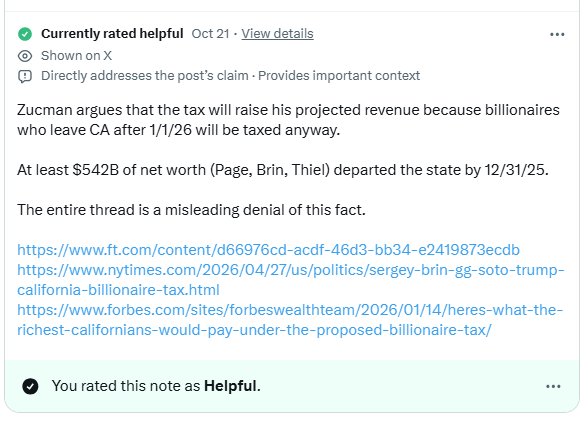
Zucman got extensive airtime to essentially deny that any billionaire succeeded in leaving the state before January 1, 2026, which prompted my “oh please.” He made the same point on X and received a pointed community note for it:
I did get to respond to this. But most of my airtime was consumed responding to Sorkin’s multiple inquiries about why I’m not advocating for other revenue measures and what other taxes I would recommend instead. I can’t resist a baseball analogy. It’s like saying to Mets fans, after their team spent nearly $1 billion over two years and missed the playoffs both times: “I get that you don’t want to raise ticket prices so the team can pay its players and managers even more, but would you consider more expensive hot dogs or beer?
To elaborate on some of the specific points I made about why California has a spending problem, not a revenue problem:
Total Medi-Cal funding has more than doubled since FY 2019, rising 123% to $219 billion in FY 2027. California has 13.5 million households in total, not just those with someone on Medi-Cal. That works out to more than $16,000 per California household.
Federal funding for Medi-Cal has risen almost as fast, up 113% since FY 2019. Last year’s reconciliation bill slows that growth, which hardly amounts to a fiscal emergency requiring California to start seizing its citizens’ assets.
General Fund and total state spending are both up 79% since FY 2019. Total spending is $538.9 billion, nearly $40,000 per household, and that is state spending alone, excluding local governments. Do citizens feel they’re getting their money’s worth?
California has $75 billion more in liquid securities on its balance sheet than it did in FY 2019. Where is the fiscal emergency that requires targeting $100 billion in asset seizures (which the state won’t collect anyway)?
The state’s choice to cover illegal immigrants costs it as much as $10 billion per year. As Kernen pointedly argued, money is fungible, so you can’t claim that “federal funds don’t pay for that.”
Zucman claims that 3 million people will lose health care if Proposition 40 doesn’t pass. This is scaremongering. The proposition’s own drafters put the figure at around half that in their expert report, but more importantly our analysis shows that even that number mostly reflects people who fail to document a month of work or claim an exemption they qualify for, and anyone can still get treatment and apply for coverage retroactively. Meanwhile, federal Medi-Cal funds are still rising by 14% this year and the bulk of the OBBBA reductions don’t arrive until after 2030. It’s like the Mets threatening that unless those hot dog prices go up, the team will have no choice but to let its stars walk. Whether anyone loses coverage is a choice the state makes about its own priorities.
And of course there is much we didn’t get to discuss because it happened after the interview. Later in the day, allegations of systematic inaccuracies in Zucman’s work resurfaced when Tyler Cowen linked on Marginal Revolution to an AI analysis that found errors running in an “ideological direction” in 97% of cases.
There’s plenty of debate about how much weight to give this kind of AI-driven output. But one thing is clear: human economists have spent years documenting systematic inaccuracies in the work of Piketty, Saez, and Zucman, with the Independent Institute’s Phil Magness leading much of that effort. I highly recommend Phil’s X thread summarizing the “biases in this trio’s work that were found by humans”:

Given these inaccuracies, it isn’t surprising that the three claims on which the billionaire tax proposal is founded are all false: that it will raise $100 billion, that billionaires pay almost nothing in state income tax today, and that the state faces a fiscal emergency only a wealth tax can fix. None of these holds up. The revenue estimate ignores the billionaires who have already left, the litigation ahead, and the income taxes the state forfeits every year they are gone. Billionaire income tax payments to California amount to billions of dollars every year and growing. And a state whose spending is up 79% since 2019, with $75 billion more in liquid securities on its books, is hardly in an emergency.
Meanwhile, founders who could build California’s next great companies are watching, and they see where the logic of these taxes leads. The Golden State spent a century becoming the place where people come to build things. Proposition 40 would make it a place they leave as soon as they start to succeed, if they even come at all.

I hear echos of Obama's "you didn't build this." Funny thing, I get one vote in the election but a lot of votes where I live and if/how I invest my money. Obama lost the bet on me. He thought he'd stick it to me with his taxes. So I closed my businesses and stopped paying developer salaries that were pure risk capital. Who came out ahead, Obama's taxtakers or me?
https://www.independent.org/article/2026/09/24/wealth-tax-risks-destroying-innovation-engine/