


Gabriel Zucman has, again, for the third time decided to rehash his criticisms of our recent paper estimating the fiscal impact of the Billionaire Wealth Tax on California. We addressed his criticisms previously in July and earlier this month, and yet nevertheless he claims we have provided him “no answer.” While many commentators have chimed in and Zucman has actually received an X community note, we hope that the third time’s the charm for registering our own responses.
Taking his points one-by-one:
Claim 1: “There is no incentive to move to another state. One cannot avoid the tax by moving. This is one of the main reasons why it was structured as a one-time tax.”
First, as we explain in our paper, billionaires representing nearly 30% of California’s billionaire wealth left before the snapshot date with some explicitly doing so in response to the ballot proposition.
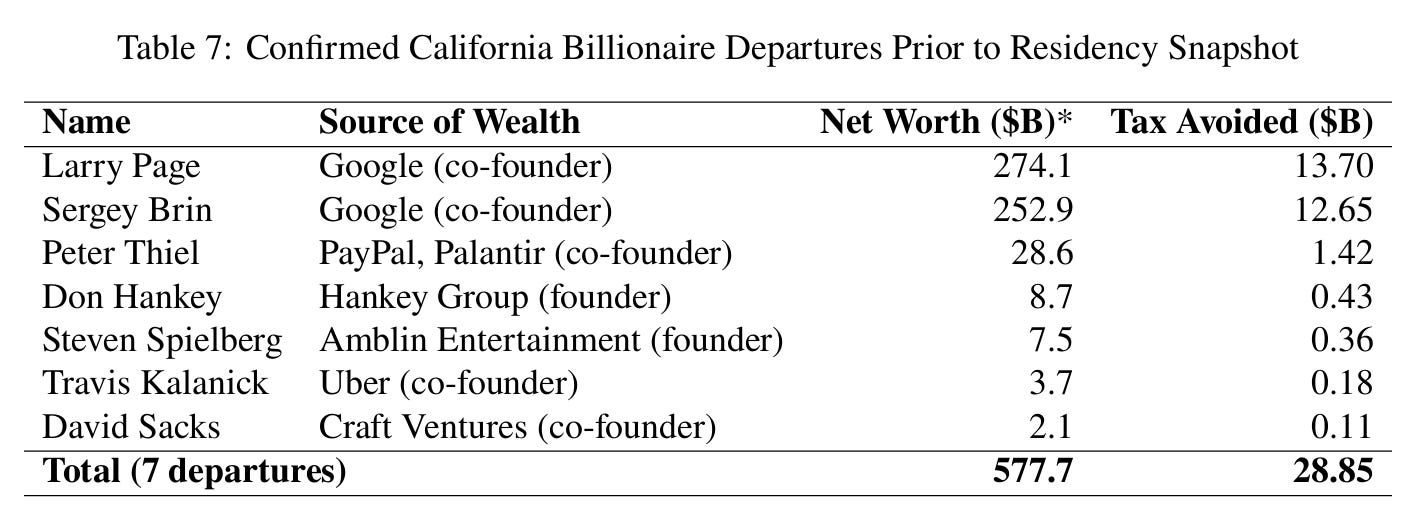
Second, billionaires still have incentives to leave after the snapshot date. They may reasonably question whether the retroactive residency provision will ultimately survive the many legal challenges it will face, and the passage of the tax may alter their expectations about future wealth taxation.
Claim 2: “Why would billionaires permanently leave California in response to a one-time tax owed if they lived there on January 1, 2026? It would only make sense for them to leave if the tax becomes annual.”
There are at least two reasons why one might leave even if the proposition is described as a “one-time” tax.
First, as we note in a recent working paper on the legal questions surrounding Prop 40, there is significant doubt as to whether the tax’s retroactive residency provision will survive legal challenges. Taxpayers could rationally leave the state during 2026 insofar as they conclude that leaving California today may reduce or eliminate their eventual tax liability.
Second, taxpayers may not believe that the tax will be “one-time.” Even if billionaires consider the initial 5% tax insufficient reason to leave California, the belief in the possibility of future, additional wealth taxes could change their decision-making, regardless of whether those taxes ultimately occur or not.
This is not an unreasonable or merely hypothetical concern. Zucman himself has called the fight over California’s Prop 40 “the beginning of a global movement to end the ultra-rich’s ability to escape taxation with impunity.” Additionally, fellow Prop 40 proponent Emmanuel Saez said back in June that “we will have to see whether this one passes and then whether it makes sense to do a permanent wealth tax down the road.”
Claims 3 & 4: (i) They assume that billionaires will leave permanently, frightened by the prospects of an annual wealth tax. But they just count the revenue from the one-time wealth tax. Not the revenue from the annual tax. The annual tax that triggered the “exodus” Jaros and Rauh imagine never materializes. For one, it’s a basic violation of rational expectations, a cornerstone of modern economics.
(ii) Either the tax is annual – and in that case it generates revenue annually, and some billionaires leave. Or the tax is one-time – in that case it generates revenue in just one year, and there is no incentive to leave. It can’t be both at the same time.
This criticism shows a fundamental misunderstanding of what rational expectations actually means. Rational expectations do not require taxpayers to be able to predict the future with absolute certainty. People make all sorts of decisions based on the probability of various outcomes, which often include outcomes that ultimately never materialize.
Consider a billionaire deciding whether to stay in California after the announcement of the current wealth tax. Even if the billionaire understands that the current law is written as a “one-time” measure, he or she may reasonably assume that there is a positive probability of another wealth tax in the future. This possibility alone could be sufficient to induce a taxpayer to leave the state, regardless of whether a future wealth tax is ever implemented.
Importantly, these decisions can influence a government’s future policy choices. As billionaires decide to leave California, the potential revenue from subsequent wealth taxes shrinks. A shrinking base could make lawmakers less likely to pass an additional wealth tax. As the old Chinese proverb goes, quoted by Nobel laureate Thomas J. Sargent, “The government has strategies; the people have counterstrategies.” In other words, the relationship between the government and taxpayers works in both directions: governments respond to taxpayers’ behavior as taxpayers respond to government policy.
Furthermore, simply because future wealth taxes do not materialize does not imply that departed billionaires will return to California. Relocating to a new state places substantial costs on those departing, and once these individuals establish residency elsewhere, they may have little reason to reverse their decisions, especially if some uncertainty remains about future wealth taxation. By the same logic, the argument that “the damage is already done, so we might as well pass the tax” ignores that passage could induce further departures, discourage future arrivals, and make those who have already left even less likely to return.
Finally, we want to address this repeated claim of the necessity of including additional revenues from hypothetical future wealth taxes. If one were to do so, this would require making a series of additional assumptions about whether those taxes would actually pass, what the terms of those taxes would be, and how taxpayers would respond to them. This calculation would need to also account for the many additional departures that could occur in response to those additional taxes being realized. Otherwise, simply adding future wealth tax revenue without accounting for these departures would be inconsistent with the economic logic Zucman invokes.
As Jason Furman, former chair of the Council of Economic Advisers (CEA) under President Obama, explained in a post, our approach to scoring is in fact “the standard way to score tax policy. You score the law as written (in this case a one-time wealth tax) and the behavioral consequences from that law (people worried it will last moving).”


Or to quote a post from Marc Goldwein of the Committee for a Responsible Federal Budget and alum staff of the Joint Select Committee on Deficit Reduction, “[T]he idea that we should ignore potential behavior or count not-yet-proposed taxes is ridiculous.”

We suggest readers listen to the actual revenue estimation experts.
Rational expectations simply require people’s beliefs to be consistent with information available and the probabilities associated with different outcomes. They do not require every event assigned a positive probability to actually occur.
Claim 5: But they add the assumption that there is somehow a 50% chance the one-time tax itself will never be collected (due to “legal risk”).
The analysis provided in the paper accounts for a significant degree of legal uncertainty due to a number of provisions included in the proposed wealth tax.
As we indicate in the paper, the proposed tax faces several constitutional challenges, which include multiple questions surrounding its retroactive residency provisions, its treatment of taxpayers residing abroad, as well as its valuation of certain assets. Each challenge could impact the amount of tax revenue the state of California ultimately collects.
With this in mind, we rely on a 50% collection probability as our central estimate. We treat this as a modeling parameter informed by the Financial Accounting Standards Board’s guidance on uncertain tax provisions (i.e., ASC 740-10). This should obviously not be interpreted as a claim that we know the exact probability of how a court may ultimately rule.
This is fairly standard practice. The Joint Committee on Taxation similarly considers “compliance, administration, and enforcement issues that could affect the timing or amounts of revenues collected.” So, while this may be inconvenient for proponents’ revenue expectations, it is a perfectly reasonable consideration in light of the unprecedented nature of various provisions included in the ballot proposition.
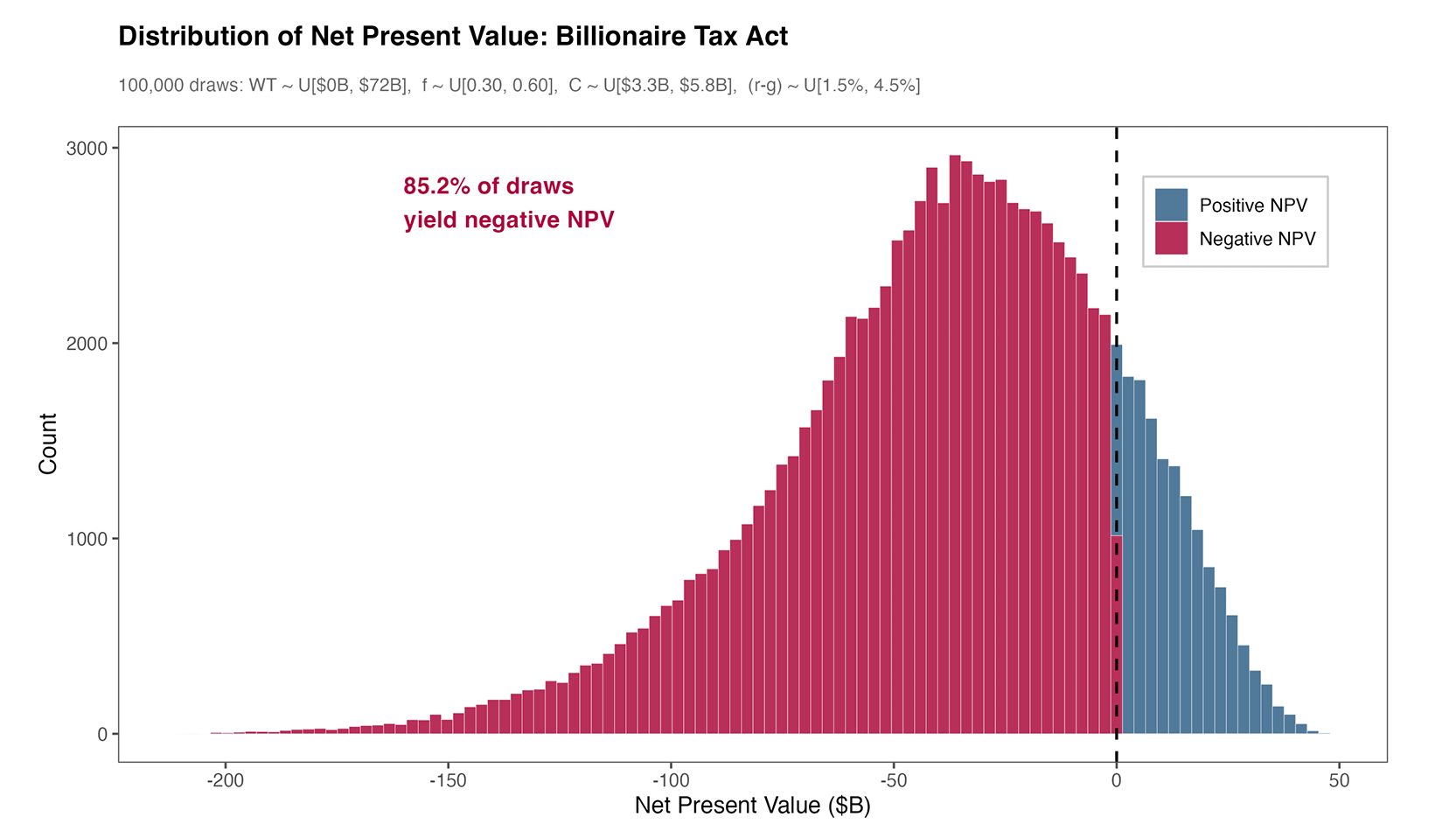
Importantly, our main results do not depend on introducing litigation uncertainty to find a substantial behavioral response. Before applying the litigation adjustment, the seven documented pre-2026 departures alone reduce potential wealth tax collections from roughly $101 billion to $72 billion.
Zucman also points to Meta’s recent SEC filing as evidence that Zuckerberg is preparing to pay the tax. But preparing for a potential tax liability does not mean accepting its legality or ruling out a legal challenge. Indeed, Zuckerberg could arrange to pay the tax while preserving his ability to contest it in court. This is precisely why accounting for litigation uncertainty matters.
Nor does this development overturn our headline NPV estimate of −$38.9 billion, which already incorporates a distribution of wealth-tax revenues extending to $72 billion, built on scenarios in which Zuckerberg remains in the taxable base.
Claim 6: The second big issue in their work involves their estimate of how much income tax the top California billionaires (those they assume will leave) actually pay. They overstate it by a factor of 5. That’s because they do not have data on the income tax paid by those top billionaires (e.g., Brin and Page). By contrast, we have direct data on this, from the Securities and Exchange Commission, where we can see compensation, dividends, and stock sales for Page, Brin, and other top billionaires.
To start, it is worth mentioning that our estimates of aggregate income tax payments by California billionaires are relatively close to those of Boll, Saez, and Zucman. Their paper estimates approximately $3.2 billion annually, while our paper estimates revenues of approximately $3.3 and $5.8 billion.
Therefore, it should be clear that the disagreement is not about whether California billionaires pay five times as much income tax as the proponents estimate. Instead, it primarily concerns how those payments are distributed among taxpayers, particularly the billionaires who have departed from California.
Zucman claims that he has “superior” data on the income taxes paid by individuals like Larry Page and Sergey Brin; however, this is misleading. He relies on SEC filings, which includes information on stock sales, dividends, and compensation, but they importantly do not reveal an individual’s complete taxable income or California income tax liability.
Our paper relies on public California Franchise Tax Board tabulations to estimate aggregate billionaire income tax payments. We then provide a range of possible losses attributable to migration. In addition, we account for a potential difference in the fraction of wealth tax base that could leave (see page 30 of our paper), not being tied one-to-one to income taxes, which makes the realized range of income tax losses used in the actual simulation around 1 billion to 3.5 billion (see page 34).
With calculations of this kind, there is naturally some uncertainty in estimating future income tax losses. However, methodological differences in attempting to reconstruct the tax payments of a small group of taxpayers do not, in and of themselves, justify the claim that our projections are “overstated by a factor of 5.”
In sum, this is now the third time we have addressed Zucman’s criticisms. He is free to continue calling our analysis “deceptive,” “inappropriate,” or “spectacularly misleading.” We trust fair-minded, discerning readers (and voters) to decide for themselves whether a paper that documents observed departures, applies standard adjustments and response parameters, and attempts to distinguish probabilities from certainties is the one that fails basic economics — or whether the criticism that has repeatedly misrepresented both our paper and the concept of rational expectations is the one that does.
Outstanding post!
The paper's assumption that the potentially mobile billionaires pay any California income tax at all is D- work, based entirely on some flimsy assumptions. It's easy to run down the list of these billionaires and confirm that they don't have any taxable income. It's also easy to run down a list of high-income California (Lebron, Ohtani, etc.) and verify that they are high-income but probably not billionaires and not able to migrate. A conservative estimate of the income taxes paid by potentially mobile billionaires is $0, and, whatever number they put forward, I'll take the under.